

SwiftFP Tax Software — Step-by-Step Instructional GuideHow to Prepare an Amended Return
OVERVIEW
What is an Amended Return?
An amended return is filed when a previously accepted tax return needs correction due to missing income, incorrect filing status, missed deductions, or other reporting errors. Use Form 1040-X to make corrections after the IRS has accepted your original filing.
Missing Income
Forgot to include a W-2, 1099, or other income source
Wrong Filing Status
Incorrectly filed as Single, MFJ, MFS, HoH, or QW
Missing Deductions
Overlooked itemized deductions, credits, or adjustments
Incorrect Personal Info
Name, SSN, address, or dependent information errors
Missing Income
Forgot to include a W-2, 1099, or other income source
Wrong Filing Status
Incorrectly filed as Single, MFJ, MFS, HoH, or QW
Missing Deductions
Overlooked itemized deductions, credits, or adjustments
Incorrect Personal Info
Name, SSN, address, or dependent information errors
Always confirm IRS acceptance before filing an amendment. You cannot amend a return that has not yet been accepted.The IRS generally allows amendments within 3 years from the original due date, or 2 years from tax paid — whichever is later.
Scenario 1
Original Return Prepared by You
Return was accepted. Access via Client Manager → Others → File Amended Return.
Scenario 2
Original Return by Another Preparer
Create New Return → Select 1040X. Enter original amounts exactly as filed.
Scenario 1
Original Return Prepared by You
Return was accepted. Access via Client Manager → Others → File Amended Return.
Scenario 2
Original Return by Another Preparer
Create New Return → Select 1040X. Enter original amounts exactly as filed.

Scenario 1
Original Return Prepared by You
(Already Accepted)
The original return was accepted by the IRS. Access amendment via Client Manager.
Before You Begin:
- IRS acceptance confirmed
- Original return copy on hand
- Corrected documents ready
- Client signed consent

Log into SwiftFP and Navigate to Client Manager
1. Open SwiftFP and sign in with your preparer credentials.
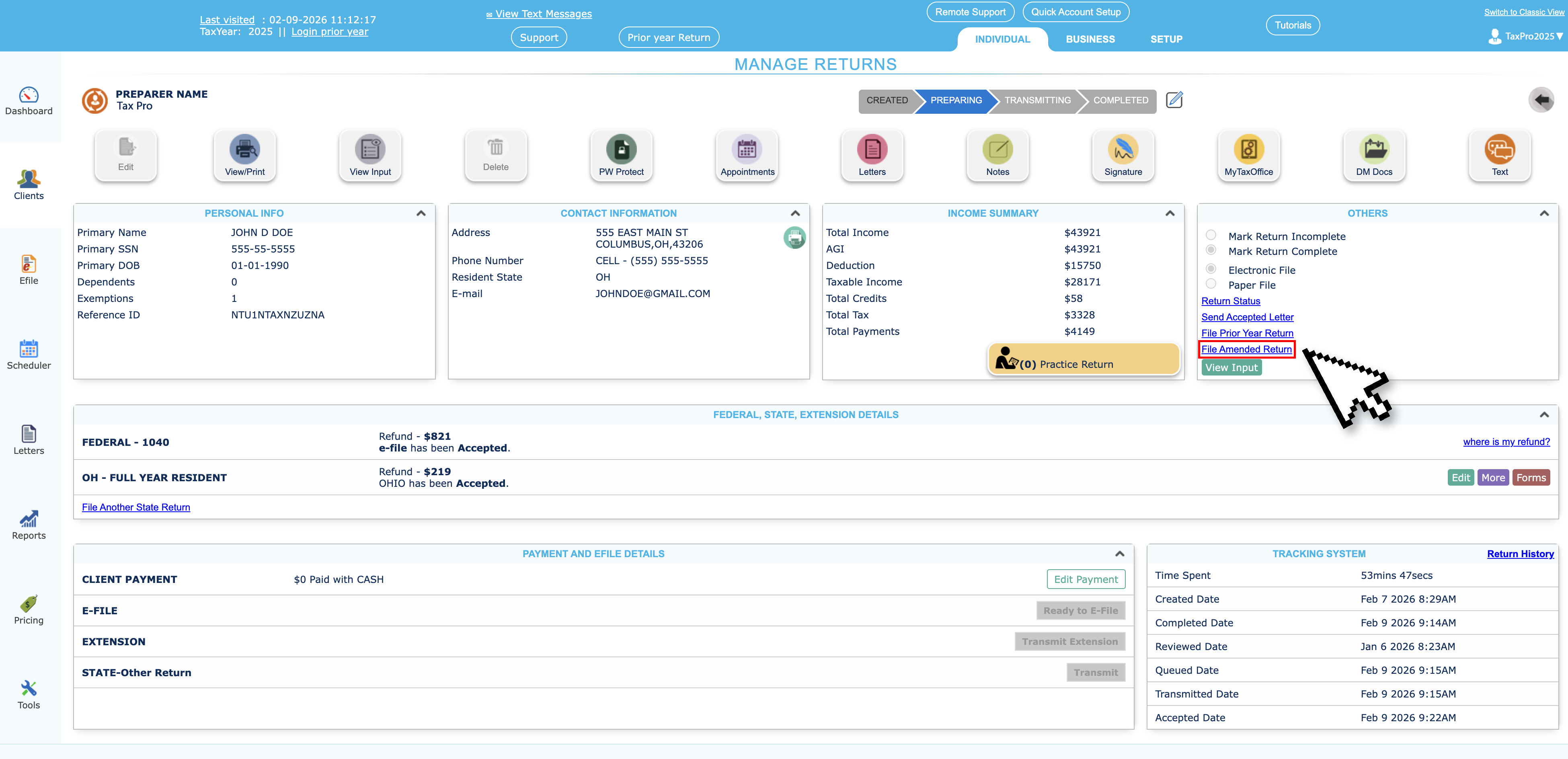
2. From the left navigation panel, click Clients to open Client Manager.
3. Search for and select the appropriate taxpayer from your client list.

Locate the ‘File Amended Return’ Option
1. In the Client Management screen, locate the ‘Others’ section on the right side.
2. Click ‘File Amended Return’ to launch the amendment workflow.
3. The system will pre-load the accepted return data automatically.

Make the Necessary Corrections
1. Navigate to the section requiring correction: Income, Deductions, Credits, or Personal Info.
2. Enter the correct/updated information — do NOT zero out the original entries first.
3. The software will automatically calculate Column B (net change) and Column C (corrected amounts).
4. Review each changed line carefully before proceeding to ensure accuracy.
5. Complete Part III — Explanation: provide a brief, clear reason for each change.

Review, Print, and File the Amended Return
1. Use View/Print to review Form 1040-X in its entirety before submission.
2. E-file the federal amendment if eligible (2020 and later returns qualify for e-file).
3. For earlier years or state amendments — print, sign, and mail to the IRS.
4. Advise the client: IRS processing time is typically 8–16 weeks for paper 1040-X.

Scenario 2
Original Return Prepared by Another Preparer
Use Form 1040X directly. You will enter the original amounts manually from the prior return.
Before You Begin:
- Copy of prior filed 1040
- All corrected source docs
- IRS acceptance confirmed
- Taxpayer SSN verified

Create New Return and Select Form 1040X
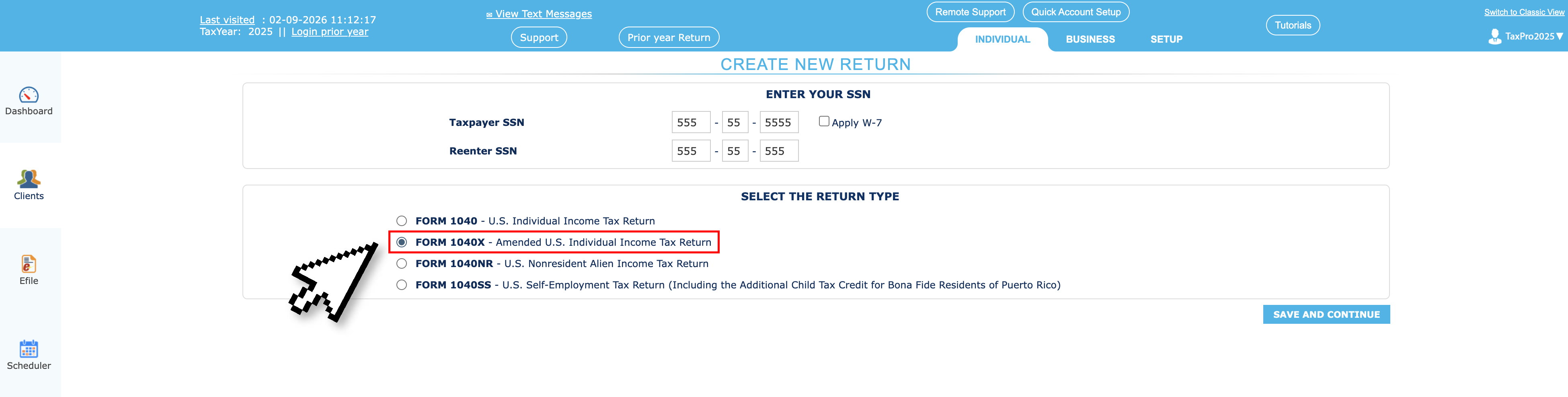
1. From the SwiftFP dashboard, click ‘Create New Return’ (or E-file → New Return).
2. Enter and verify the taxpayer’s SSN in both SSN and Re-enter SSN fields.
3. Under ‘Select the Return Type,’ choose: FORM 1040X – Amended U.S. Individual Income Tax Return.
4. Click ‘Save and Continue’ to proceed to the return preparation screen.

Prepare the Return with Correct and Complete Information
1. Complete the return as if preparing it for the first time — using only correct, verified information.
2. Do NOT replicate errors from the prior preparer’s return in any field.
3. Use all corrected source documents provided by the taxpayer (W-2, 1099, 1098, etc.).

Open Form 1040X and Enter Original Amounts in Column A
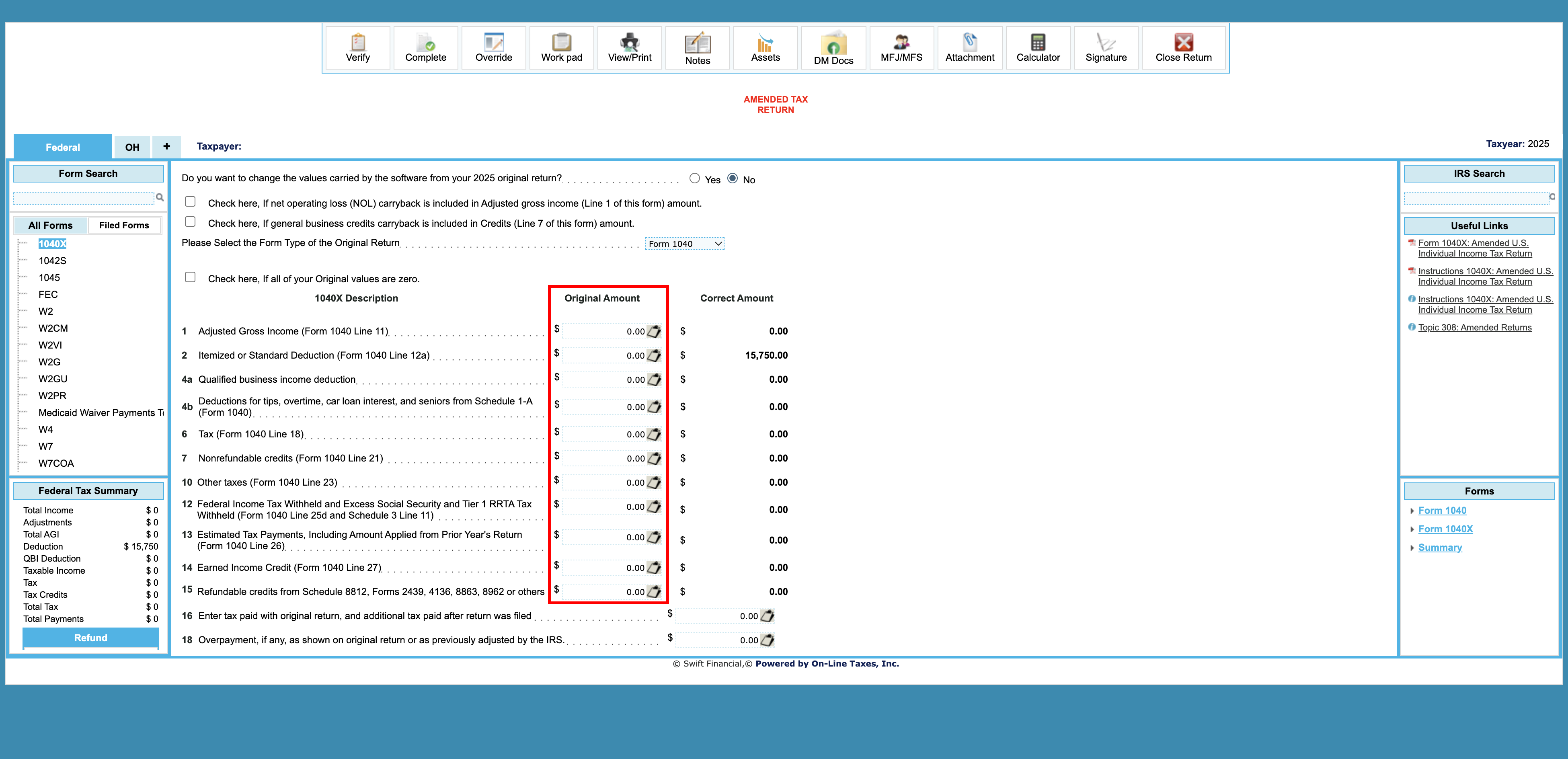
1. Navigate to Forms → 1040X within the return.
2. In Column A (Original Amount), enter amounts EXACTLY as shown on the original Form 1040.
3. Do not make adjustments — enter exact line amounts from the prior filed return.
4. After saving, SwiftFP auto-calculates Column B (net change) and Column C (corrected amounts).
5. Complete Part III — Explanation: provide a brief, clear reason for each change.
IMPORTANT REMINDERS & BEST PRACTICES
Always obtain a copy of the originally filed return
Never rely on memory — get the actual filed transcript or copy from client.
Confirm IRS acceptance before filing Form 1040-X
Verify at IRS.gov — you cannot amend a return that has not been accepted.
Provide a clear explanation in Part III
Every change must be explained clearly. Vague explanations risk IRS rejection.
Review both federal and state amendment requirements
Many states require separate forms, signatures, and have different deadlines.
Retain all supporting documentation
Keep corrected W-2s, 1099s, and client records in file for at least 7 years.
Always obtain a copy of the originally filed return
Never rely on memory — get the actual filed transcript or copy from client.
Confirm IRS acceptance before filing Form 1040-X
Verify at IRS.gov — you cannot amend a return that has not been accepted.
Provide a clear explanation in Part III
Every change must be explained clearly. Vague explanations risk IRS rejection.
Review both federal and state amendment requirements
Many states require separate forms, signatures, and have different deadlines.
Retain all supporting documentation
Keep corrected W-2s, 1099s, and client records in file for at least 7 years.

About Company
SwiftFP has provided innovative tax software solutions and services to tax professionals across the country for over ten years. We are a customer focused company with long-term strategic partnerships with industry-leading transmitters, financial product processors and other tax industry-related products.
Managed by MK Management Group
Contact Us
Columbus, OH 43206
Email: sales@swiftfp.com
Phone: (888) 550-6119
Fax: (614) 500-4387
Quick Links
Subscribe
Keep up with Swift FP and get instant news once in a while. We promise, no spam or similar emails, just pure goodiness.
About Company
Swift FP has provided innovative tax software solutions and services to tax professionals across the country. We are a customer focused company with long term strategic partnerships with industry leading transmitters, bank product processors and other tax related financial products.
Managed by MK Management Group
Contact Us
Columbus, OH 43206
Email: sales@swiftfp.com
Phone: (888) 550-6119
Fax: (614) 500-4387
Quick Links
Subscribe
If you wish to receive our latest news in your email box, just subscribe to our newsletter. We won’t spam you, we promise!
Copyright Swift Financial Partners. All rights reserved.