
How the new Trump Account works, who qualifies, and what tax professionals must get right in 2026
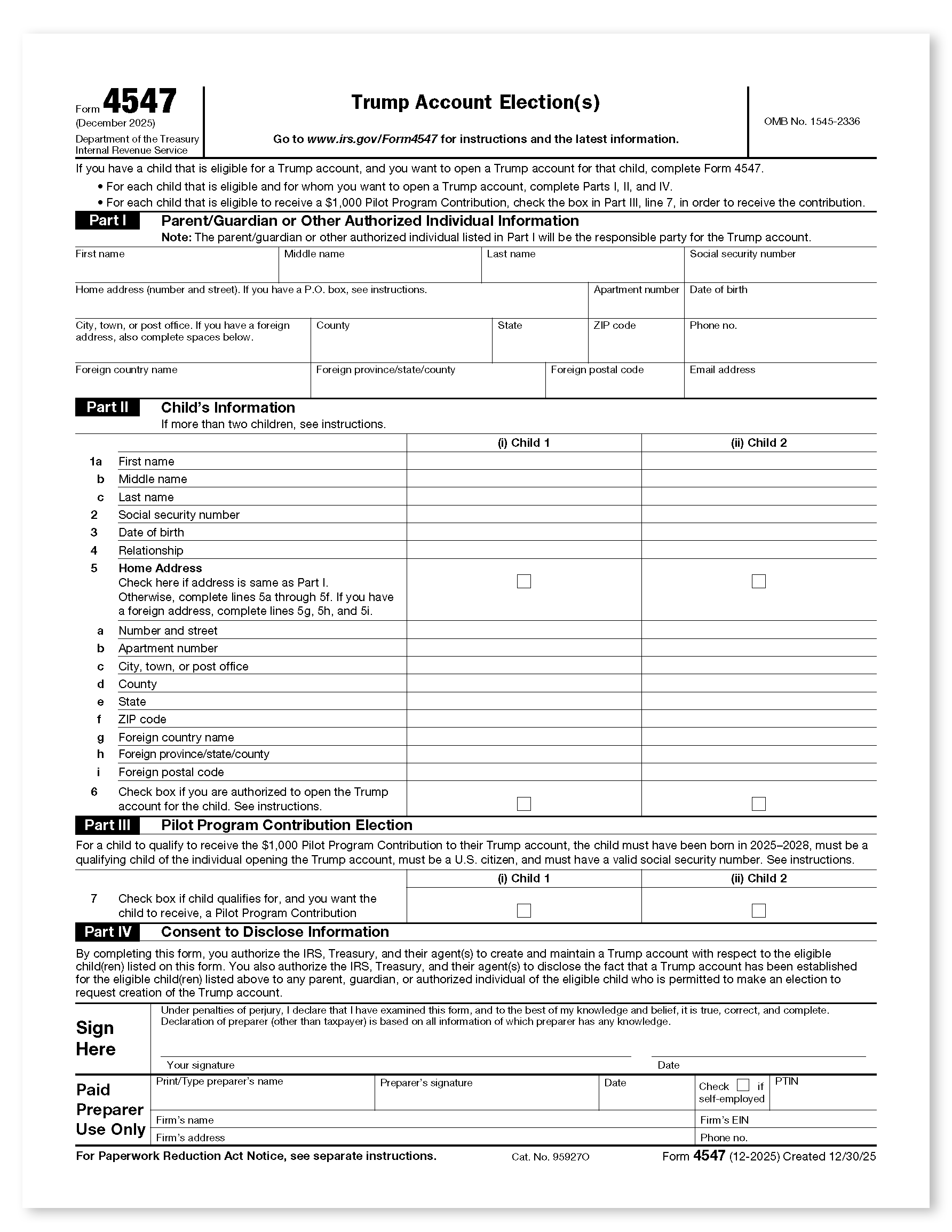
Starting in 2026, tax professionals will be responsible for one of the most unusual—and powerful—child-based tax elections the IRS has ever introduced: Form 4547.
This form allows eligible families to open a Trump Account (a special child-owned IRA) and, for many newborns and young children, claim a $1,000 U.S. Treasury pilot contribution.
This is not a refundable credit on the return.
It is federal money deposited directly into a child’s investment account.
If it is missed, it is gone.
Here is what every preparer needs to understand.
What Is Form 4547?
Form 4547 is the IRS election used to:
- Create a child’s Trump Account, and
- Request the $1,000 Treasury pilot contribution when the child qualifies.
The form does not create an IRA in the normal sense. It authorizes the U.S. Treasury to open and fund a federally-regulated child investment account that grows tax-deferred until adulthood.
What Is a Trump Account?
A Trump Account is a special type of traditional IRA owned by a child.
It has:
-
Federal investment restrictions
-
Special contribution rules
-
Severe withdrawal limits until age 18
-
A government seed deposit for qualifying children
The child is the legal owner.
The adult who files Form 4547 becomes the Responsible Party and controls the account until the child reaches adulthood (18).
Who Qualifies for the $1,000 Treasury Deposit?
A child must meet all of the following:
Requirement and Rule
Birth window: Born after 12/31/2024 and before 1/1/2029
Citizenship: Must be a U.S. citizen
SSN: Must have a valid SSN issued before filing
Prior Benefit: Must never have received a prior pilot contribution
Relationship: Must be the tax filer’s qualifying child
Age: Must be under 18
This means newborns and toddlers born 2025–2028 are the target population.
What Is the $1,000 Credit?
The “credit” is not claimed on Schedule 3.
It is a direct $1,000 Treasury contribution deposited into the child’s Trump Account.
This is real federal money that:
-
Is not taxable when deposited
-
Is not counted toward annual contribution limits
-
Can grow for 18+ years
The earliest the government can fund it is July 4, 2026.
Who Qualifies for the $1,000 Treasury Deposit?
A child must meet all of the following:
Requirement and Rule
Birth window: Born after 12/31/2024 and before 1/1/2029
Citizenship: Must be a U.S. citizen
SSN: Must have a valid SSN issued before filing
Prior Benefit: Must never have received a prior pilot contribution
Relationship: Must be the tax filer’s qualifying child
Age: Must be under 18
This means newborns and toddlers born 2025–2028 are the target population.
What Is the $1,000 Credit?
The “credit” is not claimed on Schedule 3.
It is a direct $1,000 Treasury contribution deposited into the child’s Trump Account.
This is real federal money that:
-
Is not taxable when deposited
-
Is not counted toward annual contribution limits
-
Can grow for 18+ years
The earliest the government can fund it is July 4, 2026.
Who Is Allowed to File Form 4547?
There are two sets of rules.
If you are only opening the account
The authorized person must be, in this order:
-
Legal guardian
-
Parent
-
Adult sibling
-
Grandparent
If a lower-priority person files, they are legally certifying that no higher-priority person is available.
If the $1,000 is being requested
The filer must:
- Expect the child to be their qualifying child for that tax year
They do not have to actually claim the child on the return for the election to remain valid.
When Can Money Go Into These Accounts?
No money of any kind—government, employer, parent, or state—can be contributed before:
July 4, 2026
How Much Can Be Contributed Each Year?
There are two buckets of money.
Unlimited sources (do not count toward caps)
-
Treasury $1,000
-
State grants
-
Nonprofit contributions
-
Rollovers
Capped Sources
-
Parent or family contributions
-
Employer Section 128 contributions
The annual cap for those is:
$5,000 per child per year
Employer portion capped at $2,500
Common Client Questions
“Is this taxable income?”
No. Treasury deposits, state grants, and employer contributions are not income to the child.
“Is this a tax credit on my return?”
No. It is a government deposit into the child’s account, not a line on Schedule 3.
“What if we don’t file Form 4547?”
The child gets nothing. The government does not open these accounts automatically.
“Can divorced parents both claim it?”
No. Only one authorized individual can make the election.
“Does it affect FAFSA or SSI?”
Possibly. The account is owned by the child, which may affect future financial aid calculations.
Can Parents Access the Money?
No.
Before age 18, money can only leave the account for:
-
A rollover to another Trump Account
-
Transfer to an ABLE account at age 17
-
Excess contribution corrections
-
Death of the child
After age 18, it becomes a normal IRA with early withdrawal penalties.
Common Client Questions
“Is this taxable income?”
No. Treasury deposits, state grants, and employer contributions are not income to the child.
“Is this a tax credit on my return?”
No. It is a government deposit into the child’s account, not a line on Schedule 3.
“What if we don’t file Form 4547?”
The child gets nothing. The government does not open these accounts automatically.
“Can divorced parents both claim it?”
No. Only one authorized individual can make the election.
“Does it affect FAFSA or SSI?”
Possibly. The account is owned by the child, which may affect future financial aid calculations.
Can Parents Access the Money?
No.
Before age 18, money can only leave the account for:
-
A rollover to another Trump Account
-
Transfer to an ABLE account at age 17
-
Excess contribution corrections
-
Death of the child
After age 18, it becomes a normal IRA with early withdrawal penalties.
Why This Matters for Tax Pros
Missing this form means missing $1,000 per child in government-funded retirement capital.
That is not a rounding error. It is a generational asset.
Form 4547 can be found in your SFP WorksTax Software account.
Login at the link below.